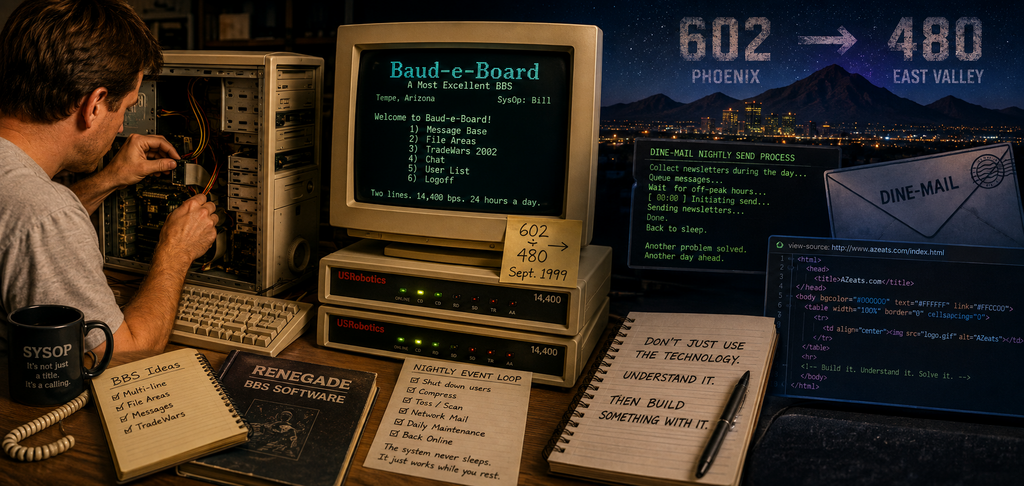
Long before AZeats.com, Bill was already drawn to computers—not simply as something to use, but as something to understand and build.
When the time came to get his first PC, Bill didn't buy a finished computer. He bought a bare-bones computer and built it himself. He wanted to understand what was inside the machine and how it worked.
He had a similar reaction to the early online services. While others were discovering services such as CompuServe, AOL and Prodigy, Bill wasn't particularly interested in simply using someone else's system. He wanted to build his own.
So he built a BBS—Bulletin Board System.
That experience was an early glimpse of the approach that would later define AZeats. Bill wasn't content to simply use technology. He wanted to understand it, experiment with it, and create something with it.
When the World Wide Web arrived, that instinct continued. Rather than simply "surfing the Web," Bill often looked at the source code behind the pages.
The pattern was already there before AZeats existed:
Don't just use the technology. Understand how it works. Then build something with it.
That mindset would become one of the foundations of AZeats.com and the many systems that followed.
The Story of Baud-e-Board BBS
In the landscape of the late 1980s and the 1990s Phoenix telecom boom, the East Valley’s subculture thrived on a network of hobbyist-run Bulletin Board Systems (BBSs). Long before the modern internet consolidated the digital world, communities were intensely local, organized by telephone area codes, and built by dedicated System Operators (SysOps). Among these digital nodes was the Baud-e-Board BBS, a two-line system operated by SysOp Bill, out of Tempe, Arizona, under the banner tagline: "Baud-e-Board, A Most Excellent BBS."
Technical Infrastructure
Operating a multi-line BBS in the 1980s and 1990s required significant technical ingenuity and financial commitment. While many hobbyist systems ran on a single line—meaning callers frequently hit a busy signal, Baud-e-Board offered an elevated user experience by running two dedicated user nodes.
Bill, built the system on an Intel 386 PC. To manage multiple callers simultaneously on a single machine, multi-line SysOps of this era typically relied on multitasking environments like Quarterdeck’s DESQview or IBM's OS/2. These systems carved up the 386's memory to allow DOS-based software to handle independent lines without crashing. The system was paired with two 14,400 bps modems, representing the absolute peak of dial-up speed. To support this infrastructure alongside daily life, Bill needed three distinct analog landlines (one personal, two for the BBS).
Transitioning Across Area Codes
Baud-e-Board originally served users under the expansive 602 area code, which covered the entire Phoenix metropolitan area. In September 1999, as dial-up internet and cellular phones flooded the valley with demand for new numbers, the East Valley officially split off into the 480 area code. Baud-e-Board transitioned with it, continuing to serve its community of callers in Tempe, Mesa, and the surrounding areas into the twilight of the dial-up era.
Today, systems like Baud-e-Board BBS stand as important milestones in the evolution of social networking and online gaming, preserved by the memories of the SysOps who kept the lines open.
The Nightly Event Loop
Baud-e-Board was powered by Renegade BBS software, a Pascal-based platform that evolved from the popular WWIV source code. Renegade was highly regarded for its robust file-tagging systems, security configurations, and vibrant ANSI text menus.
The board provided a full suite of traditional BBS features, serving as a hub for shareware distribution, message boards, and classic text-based gaming, highlighted by the legendary strategy game TradeWars.
A defining characteristic of Baud-e-Board’s daily operation was its automated nightly maintenance routine. Every night, the software would automatically shut down user access to trigger the system's "event loop." During this offline window, the computer would initialize a connection via its modems to compress, toss, and scan network message packets—exchanging data with broader networks—while simultaneously running daily maintenance scripts for games like TradeWars to regenerate alien fleets, reset turn limits, and post the daily in-game newspaper. A message written on Monday would typically receive its reply on Wednesday because BBS mail moved only during the nightly store‑and‑forward events.
This nightly event would later inspire a creative way to solve an AZeats dilemma.
When Cox Cable Shut Down the eMail
Dine-mail eventually created a problem that, by today's standards, sounds almost unbelievable. The newsletters were being sent from a server in Bill's home office, and as the number of restaurant subscribers grew, the volume of email being generated by Dine-mail grew with it. One day, Cox Cable shut down Bill's Internet connection because of the unusually high volume of email being sent from his location. The emails weren't personal messages or spam—they were legitimate restaurant newsletters being generated by the AZeats Dine-mail system.
The solution was another example of AZeats adapting its technology to solve a problem that didn't have an off-the-shelf answer. Bill had Joe modify Dine-mail so that newsletters submitted during the day were collected and held until after midnight. Instead of sending hundreds or thousands of messages throughout the day from Bill's home connection, Dine-mail would wait until the middle of the night and send the accumulated newsletters when Internet traffic and the activity from Bill's connection were much lower. It was a very early Internet problem requiring a very early Internet solution.
An alternative to the above problem was a T1 line, which in theory would have solved the issue by providing a dedicated, business‑grade connection immune to Cox Cable’s residential throttling. But in practice, a T1 was not feasible for a home office in Tempe at the time. The cost alone—often $800 to $1,200 per month for a full T1 circuit—was far beyond what a small, self‑funded operation like AZeats could justify. Installation required a clean, dedicated copper pair from the telephone company’s central office, professional wiring inside the home, and specialized hardware such as a CSU/DSU and business‑class router. Even then, carriers frequently refused to install T1 circuits in residential neighborhoods unless the homeowner signed business‑grade contracts and committed to multi‑year terms. For a startup running a newsletter server out of a closet, the financial and logistical burden of a T1 made it an unrealistic option, forcing AZeats to innovate with the midnight‑delivery workaround instead.
The midnight‑delivery system turned out to be a remarkably effective workaround. By shifting all outgoing Dine‑mail traffic to the quietest hours of the night, AZeats avoided triggering Cox Cable’s residential volume limits while still ensuring that every restaurant’s newsletter reached its subscribers. It also gave the home‑office server room—really just a closet with a humming tower PC—a predictable rhythm: collect messages all day, then quietly push them out while the rest of Tempe slept. What could have been a costly infrastructure crisis instead became another example of AZeats solving early‑Internet problems with creativity rather than expensive hardware, allowing the business to keep growing without the burden of enterprise‑grade connectivity.
The Closet Server Room
The little server room itself became part of the AZeats legend. It wasn’t a data center so much as a repurposed 6‑by‑6 closet with a bathroom fan ducted into the ceiling to keep the heat under control. A tall tower PC sat in a small rack, humming day and night as it queued and delivered newsletters. Bill even ran a dedicated electrical outlet into the closet to keep the system stable, turning a simple storage space into a miniature operations center. It was a scrappy, home‑built solution that perfectly reflected the era—when ingenuity mattered more than square footage, and when a well‑ventilated closet could power an entire restaurant‑marketing platform across the Valley.
The Pattern Continues
The story of the BBS and the Cox Cable problem are separated by years and entirely different technologies, but the connection is unmistakable. Bill had learned long before AZeats that technology could be adapted when the original solution wasn't good enough. On Baud-e-Board, nightly maintenance was simply part of keeping the system running. Years later, when Dine-mail grew beyond what a residential Internet connection could comfortably handle, that same way of thinking provided the answer: change the system rather than abandon the idea. Joe programmed Dine-mail to gather the day's newsletters and send them after midnight, allowing AZeats to continue growing. In many ways, this small story captures the spirit of the entire AZeats experience—build it, see what happens, solve the problem, and keep moving forward.