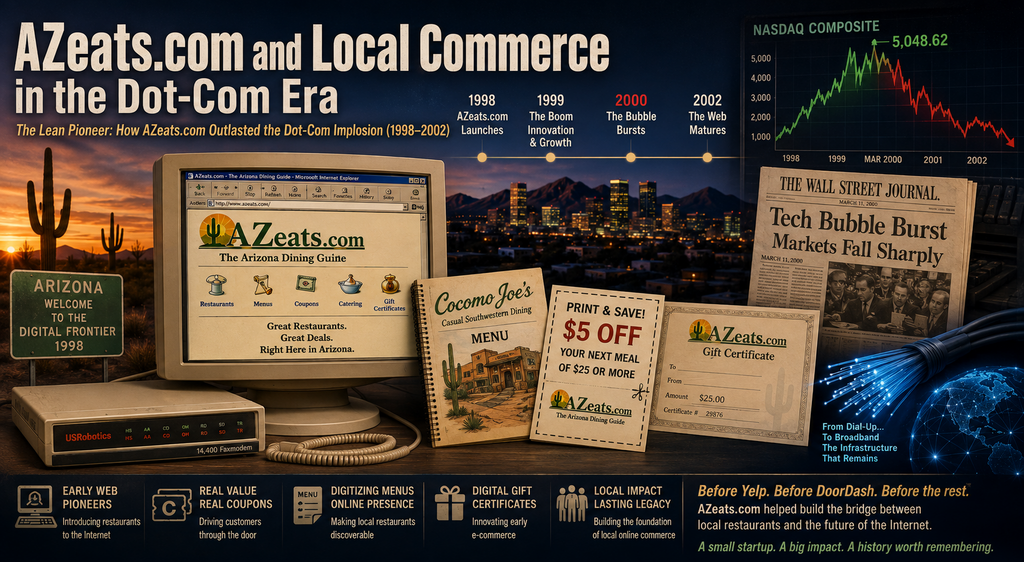
Between late 1998 and early 2002, the development of the Internet underwent its most volatile, hyper-growth, and foundational transformation in history. Defined primarily by the spectacular rise and catastrophic burst of the Dot-com Bubble, this brief window saw the World Wide Web transition from an experimental, dial-up novelty into a highly commercialized global infrastructure.
While Silicon Valley giants and multi-million-dollar failures like Pets.com and Webvan dominated the national headlines, a quieter, parallel revolution was happening at the local level. In the desert of the American Southwest, a small startup named AZeats.com was operating on the front lines of this digital frontier, serving as a perfect case study for how the early web transformed main street commerce.
The Gold Rush Era (Late 1998 – Early 2000)
In 1998, as venture capitalists flooded Silicon Valley with cash, the concept of using the internet for everyday tasks was still completely alien to the average consumer. Most people logged onto the web via noisy dial-up modems to check email or browse basic text directories.
The early web started as a slow, novel dial-up experience before moving to simple link directories like Yahoo!. Over time, it evolved into helpful local websites like AZeats that gave people real, everyday tools like digital coupons and restaurant menus.
Amid the early internet’s era of experimentation and rapid change, AZeats.com entered the scene with a clear, down‑to‑earth mission: to become Arizona’s first online dining guide and restaurant directory. As people across the state were discovering the web for the very first time, the Tempe startup focused on a simple, local need—helping neighborhood restaurants reach this new digital audience. Rather than chasing sweeping, world‑scale ambitions, AZeats.com concentrated on a practical, community‑rooted purpose: connecting independent eateries with the growing number of early web explorers.
During the peak of the boom in 1999, when the NASDAQ index surged by an unprecedented 86%, AZeats.com was introducing local businesses to radical new concepts.
For local spots like Cocomo Joe's in North Scottsdale, having a dedicated landing page under the AZeats directory (e.g., azeats.com/cocomojoes) was their very first introduction to the digital economy.
The Structural Shift: Portals vs. Algorithms
At the turn of the millennium, the way people navigated the internet was fundamentally changing. Up until late 1998, web portals like Yahoo! relied heavily on human-curated directories to organize the internet. If you wanted to find food in Phoenix, you had to click through endless sub-folders: Computers and Internet ➔ World Wide Web ➔ Regional ➔ US States ➔ Arizona ➔ Cities.
AZeats.com capitalized on a massive technological shift. As Google incorporated in late 1998 and began organizing the web via automated search algorithms, localized, hyper-focused directory hubs became incredibly valuable. AZeats didn't just give restaurants a web address; it gave them a localized search presence at a time when search engines were first learning how to index the real world.
The Great Implosion (March 2000 – 2002)
On March 10, 2000, the speculative fever broke. The NASDAQ peaked at 5,048.62 before entering a brutal, multi-year freefall that would ultimately wipe out $5 trillion in market value.
When the bubble burst, internet startups that relied on burning venture capital to sustain unviable business models collapsed within months. However, the story of AZeats.com during the 2000–2002 downturn highlights a critical nuance of the dot-com crash: while the macro-economy was devastated, the actual utility of the internet continued to mature.
Speculative companies like Pets.com burned through their funding and went totally bankrupt. Meanwhile, practical startups like AZeats kept operating and grew naturally because they provided real, everyday value.
AZeats didn't go under when the venture capital money ran out because it was built on real local basics: merchant partners, actual coupons, and true customer demand. While the stock market corrected itself, internet adoption actually grew significantly, expanding to over half a billion users globally by 2002. For small startups that managed to survive on lean operational budgets, the post-crash era was marked by steady, organic integration into the daily lives of citizens.
The Lasting Legacy of the First Web Era
By the time the market finally bottomed out in October 2002, the internet looked completely different than it did in 1998. The browser wars had seen Microsoft's Internet Explorer defeat Netscape, prompting the birth of the open-source Mozilla organization. The cultural landscape had been permanently altered by peer-to-peer pioneers like Napster.
Most importantly, the immense corporate spending of the late 90s left behind a massive silver lining: thousands of miles of underground fiber-optic cables. This oversupply of infrastructure drastically lowered the cost of data, accelerating the transition from painfully slow dial-up modems to broadband internet.
Startups like AZeats.com were the unsung architects of this transitional era. Long before Yelp, DoorDash, or Google Maps existed, these early pioneers did the heavy lifting of convincing local, brick-and-mortar business owners that a digital presence wasn't just a passing fad—it was the future of commerce.
Today, projects like the AZeats History Project actively work to archive this lost digital history, reminding us that the true foundation of the modern internet wasn't just built by the billionaires of Silicon Valley, but by the small, localized startups that taught the world how to use the web.