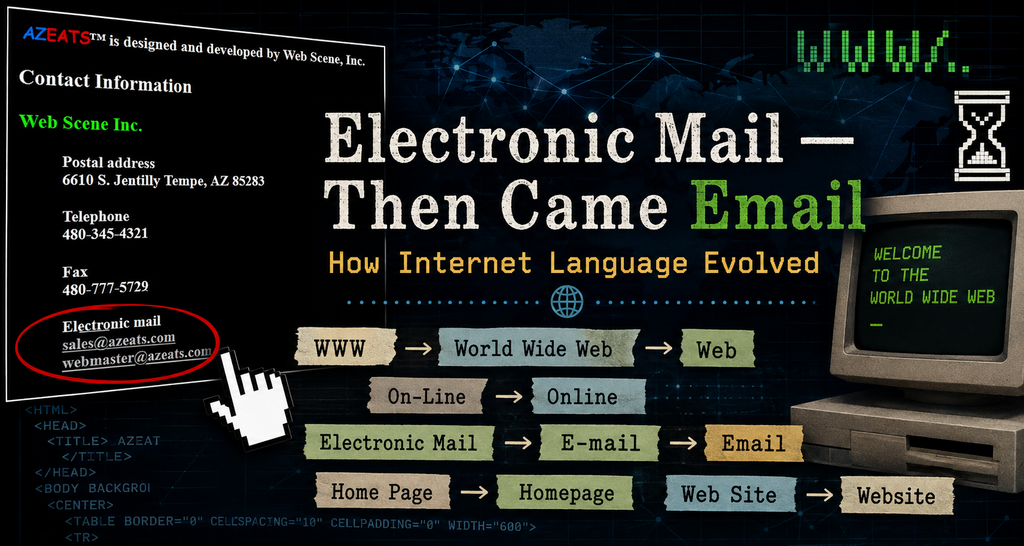
When we look back at the early years of the Internet, it is easy to forget that the language surrounding it was still being invented.
Words and phrases that seem completely ordinary today were once new, unfamiliar, and sometimes written in several different ways. Electronic Mail became E-mail, which became email. On-Line became online. Web Site became website. Home Page became homepage. And the World Wide Web, once commonly shortened to WWW, eventually became simply the Web — or, increasingly, just web.
AZeats.com provides a small but interesting window into that transition.
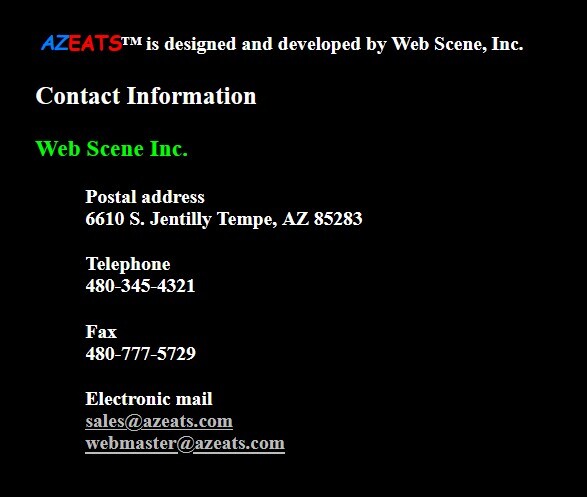
A Wayback Machine capture of the AZeats.com Contact Us page from 1999 contains a particularly good example.
At the bottom of the page, AZeats identified the company contact information under the heading:
Electronic mail
The two addresses listed were:
sales@azeats.com
webmaster@azeats.com
Today, almost everyone would simply write email.
But in 1999, Electronic Mail was still perfectly natural Internet terminology — particularly on a business website. The AZeats page preserves that terminology exactly as it appeared at the time.
It is a tiny detail, but that is what makes historical websites so interesting. The page is not merely showing us what AZeats looked like. It is showing us how people talked about the Internet in 1999.
The history of the word itself goes back much farther than AZeats.
The phrase electronic mail was being used in its modern sense by the 1970s. The shorter E-mail appeared by 1979, and CompuServe helped popularize the form EMAIL beginning in 1981.
By the 1990s, however, there was no single universally accepted spelling.
A fascinating 1995 survey of approximately 40 million words from Usenet found numerous variations, including:
email, e-mail, E-mail, Email, E-MAIL, EMAIL, EMail, eMail
The results actually showed that the hyphenated form was slightly more common in that particular collection.
Contemporary journalism also reflected the uncertainty. A 1994 Los Angeles Times article used E-Mail in its headline while describing the technology as electronic mail in the article itself.
Today, email has won the argument. Modern style guidance from Microsoft, for example, explicitly recommends email without a hyphen.
So the progression is more than a simple change in spelling:
Electronic Mail → E-mail → email
The shorter form became familiar enough that the original explanation was no longer necessary, and the hyphen eventually disappeared as the compound became an established word.
Another excellent example is WWW.
When Tim Berners-Lee developed the Web at CERN, the name was WorldWideWeb. The original browser/editor created in 1990 actually carried that name. It was later renamed Nexus, partly to avoid confusion between the program and the World Wide Web itself.
As the Web spread during the 1990s, several forms appeared:
World Wide Web
WWW
W3
Web
The W3C itself describes the World Wide Web as being commonly known as WWW, W3, or the Web.
Early websites frequently referred to themselves as being part of the World Wide Web, while URLs made www highly visible to users.
Eventually, however, “the Web” became sufficient.
Today, most people do not say:
“I found it on the World Wide Web.”
They say:
“I found it on the web.”
Modern style guides have followed the same progression. Microsoft’s current guidance recommends web rather than World Wide Web in ordinary usage and treats words such as website, webpage, and webmaster as established compounds.
On-line is another term that looks immediately dated today.
In the early Internet era, on-line was common. The hyphen helped identify the expression as a compound, just as it did with many other newly emerging technology terms.
Over time, the hyphen disappeared:
On-Line → online
The change was gradual rather than instantaneous. Even in the 1990s and early 2000s, publications and style guides did not always agree.
The modern form online has now become overwhelmingly standard.
This is an important pattern in Internet vocabulary: once a new technology becomes ordinary, its terminology tends to become shorter and visually simpler.
The same thing happened to home page.
Early Web users commonly encountered the two-word form:
Home Page
Eventually it became:
Homepage
Interestingly, homepage was already being used as a single word as early as 1993, so this was not a sudden change. Both forms coexisted for years.
That makes old websites especially valuable as historical evidence. A page written in 1998 or 1999 can preserve terminology that was perfectly normal at the time but now looks unusual.
Web site followed a similar path.
The original terminology was often written Web site or web site. Eventually the compound closed up:
Web Site → Website
Modern style guides now commonly treat website as a single word. Microsoft’s style guide, for example, lists website, webpage, webcam, webcast, and webmaster as closed compounds.
And there is an interesting connection here to AZeats.
In the late 1990s, calling something a Web site helped explain what it was. Today, website is so familiar that the explanation is unnecessary.
The word webmaster is another survivor from this period.
In the 1990s, a webmaster was often the person responsible for creating, maintaining, and updating an organization’s website.
The word itself dates to 1993.
AZeats’ 1999 Contact Us page provides a nice example of the terminology of the period: alongside the sales address was a dedicated webmaster@azeats.com address.
That was not merely an email address.
It represented a role that was becoming increasingly common as businesses began putting themselves on the Web.
Today, responsibilities that once belonged to a single “webmaster” might be divided among web developers, designers, content managers, SEO specialists, IT departments, and digital marketing teams.
The word survived, but the job changed.
There is another historical distinction worth preserving.
People in the early Web era often used Internet and World Wide Web almost interchangeably in casual conversation, but technically they were not the same thing.
The Internet is the underlying network infrastructure.
The World Wide Web is a system of interconnected webpages and related technologies that operates over the Internet.
The Web is therefore part of the Internet, not another name for the entire Internet.
That distinction is easy to overlook today because the Web became the dominant way many people experienced the Internet.
The language eventually reflected that familiarity.
Internet remained.
World Wide Web shortened to Web.
And eventually “the Internet” itself began appearing in lowercase in some contexts as internet, reflecting another long-running change in editorial style. The capitalization of Internet was itself debated as the technology evolved from a unique network into a general concept of interconnected networks.
Early Web terminology could also be much more technical.
The defining concept of the Web was hypertext — text containing links to other documents.
Today, most people simply say:
link
or
click the link
The underlying concept has not disappeared; the terminology has simply become less technical.
The same thing happened with hyperlink, hypertext, and hypermedia. These words remain accurate, but ordinary Web users increasingly interact with the technology without needing to describe how it works.
That is another recurring theme in the history of technology:
As technology becomes familiar, its vocabulary becomes less technical.
One term that did survive is URL.
URL stands for Uniform Resource Locator, and URLs became one of the fundamental ways users identified resources on the Web.
Unlike terms such as Electronic Mail and World Wide Web, the abbreviation remained useful because it provided a concise technical name for something people needed to type, copy, publish, and share.
Today we may simply call it a web address, but “URL” remains firmly established in technical and everyday usage.
Not every early Internet word became permanent.
Cyberspace was coined by science-fiction writer William Gibson in 1982 and became a popular way of describing the online world.
During the 1990s, “cyberspace” appeared everywhere — in newspapers, television, advertising, books, and discussions about the future.
Today it sounds distinctly retro.
We rarely say:
“I’ll meet you in cyberspace.”
Instead, we say:
“I’ll send you a message.”
The technology became ordinary, and the futuristic language became unnecessary.
The same fate befell information superhighway.
During the early and middle 1990s, it was a popular metaphor for the emerging digital communications infrastructure. The expression became especially prominent in public discussion during the 1990s.
For a while, it seemed like everyone was going to travel down the information superhighway.
Then people simply started saying:
the Internet
or
the Web.
By the end of the 1990s, the metaphor was already fading from everyday use.
That makes it a particularly good example of the difference between describing a new technology and living with a mature technology.
Even surfing tells us something about the era.
The expression surfing the Internet became popular in the early 1990s.
It was a colorful metaphor for the experience of moving from one website to another, following links and discovering information.
It remains understandable today, but “surfing the Web” has a distinctly early-Web flavor.
Once again, the technology changed — and so did the language used to describe the experience.
This is why that small 1999 AZeats Contact Us page is worth preserving.
At first glance, it is simply an old contact page.
It lists a postal address, telephone number, fax number, and two email addresses.
But look more closely and it becomes a tiny historical document.
Electronic mail
Webmaster
World Wide Web
On-Line
Home Page
Web Site
These were not strange or incorrect terms when AZeats was using them. They were part of the vocabulary of a rapidly developing medium.
Some survived.
Some changed spelling.
Some were shortened.
Some disappeared almost completely.
And some became so ordinary that we no longer think of them as Internet terminology at all.
When we preserve an old website, we often concentrate on the graphics.
We want to see the colors, animated GIFs, buttons, photographs, tables, fonts, and layouts.
Those things are important.
But the words are historical artifacts too.
A 1999 website can tell us not only what a company was doing, but what people thought the Internet was, what they called its technologies, and how they communicated with one another.
AZeats was created during that period when being “on-line” was still relatively new, a “Web site” was something a business was proud to have, and a “webmaster” could be a recognizable job title.
And on that 1999 AZeats Contact Us page, the company did not yet say email.
It said:
Electronic Mail.
That small phrase captures a moment in Internet history — a time when the vocabulary of the Web was still being written.
Earlier terminology | Later / modern terminology |
Electronic Mail | |
World Wide Web | Web / web |
WWW | web |
On-Line | online |
Web Site | website |
Home Page | homepage |
Webmaster | webmaster — still used, but less common |
Hypertext / Hyperlink | link |
Uniform Resource Locator | URL / web address |
Cyberspace | online / Internet |
Information Superhighway | Internet / Web |
Surfing the Internet | browsing the web |
The AZeats History Project is preserving more than old webpages.
It is preserving a snapshot of how the early commercial Web looked, worked, and sounded.
A word like Electronic Mail may seem insignificant today. In a 1999 website, however, it is evidence of the era.
And that is one of the unexpected rewards of looking closely at archived websites:
Sometimes history is hiding in the words.
AZeats.org — Preserving the story of AZeats.com and the early commercial Web.