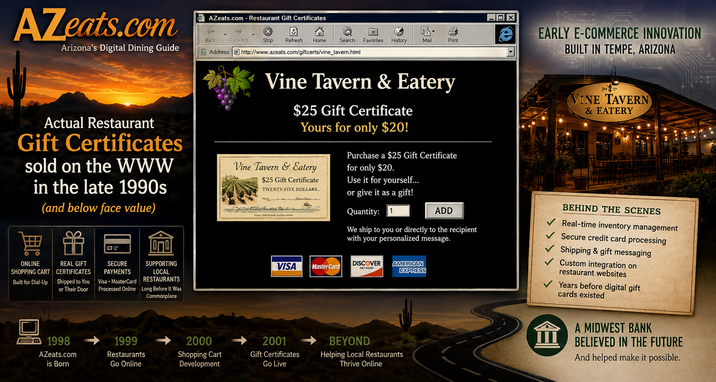
Actual Restaurant Gift Certificates sold on the WWW in the late 1990s
(and below face value)
In the late 1990s, AZeats.com was selling restaurant gift certificates below face value through a web-based mail order form and by telephone. As the number of available gift certificates and sales volume grew, AZeats adapted by developing its own shopping cart system.
The new shopping cart allowed visitors on either the AZeats.com website or an individual restaurant's website to purchase gift certificates seamlessly. Customers could browse a restaurant's website, click to buy gift certificates, complete their purchase using the AZeats shopping cart, and then be returned directly to the restaurant's website without interruption.
In addition to securely accepting credit card payments, AZeats was able to integrate a customized shopping cart into each participating restaurant's website. The shopping cart matched the restaurant's own look and feel, creating a consistent customer experience. Beyond processing sales, the system also managed gift certificate inventory. Orders could be shipped directly to the purchaser for personal use or sent as gifts to recipients, complete with a personalized message.
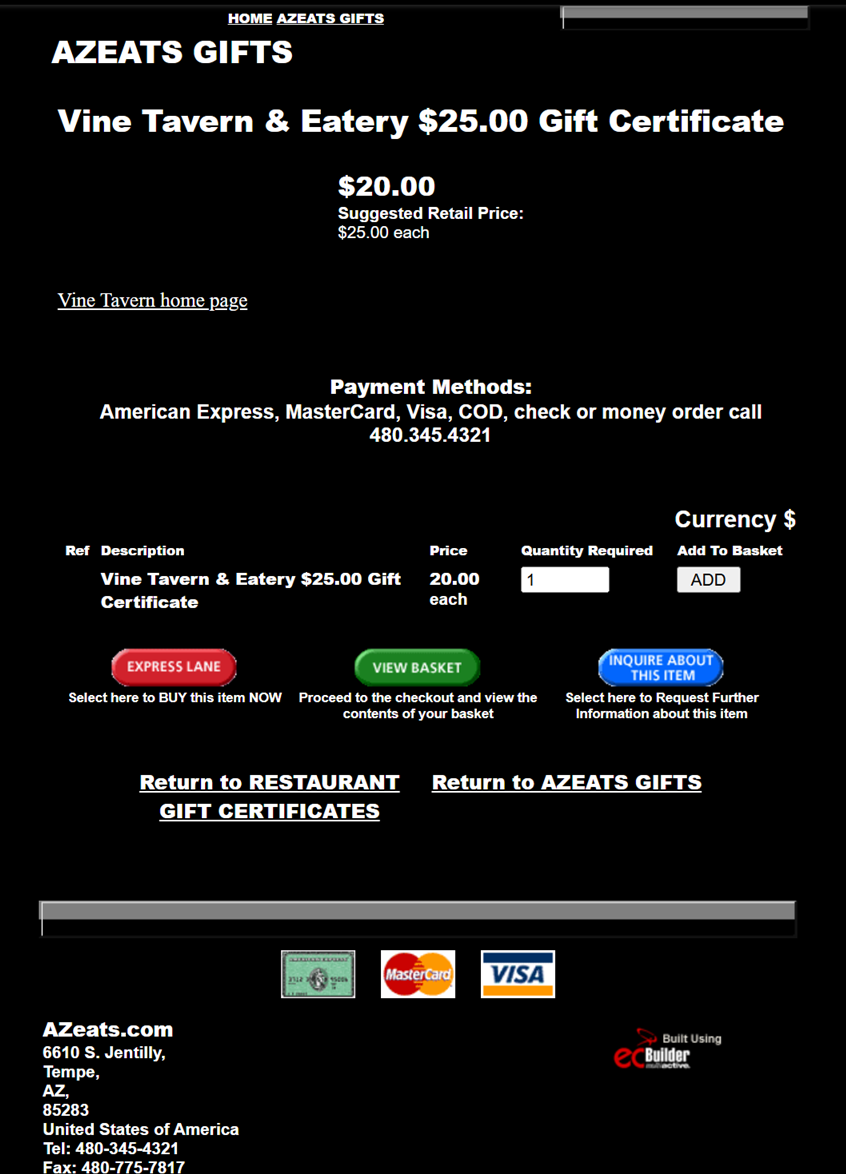
Long before smartphones and frictionless digital payments, a modest black‑background webpage appeared on AZeats.com offering a simple deal: a $25 Vine Tavern & Eatery gift certificate for twenty bucks. The page was visually stark—white text, a few credit‑card logos, and a button labeled ADD. Nothing about it screamed innovation.
Yet this unassuming page was the front door to one of Arizona’s earliest fully functional e‑commerce ecosystems. It represented a technological leap built not in Silicon Valley, but in Tempe, Arizona—crafted by a small team who believed local restaurants deserved the same digital tools as national chains.
And behind that single gift‑certificate listing lived a story of technical ingenuity and entrepreneurial stubbornness that stretched from the Arizona Desert to a small, forward‑thinking bank in America’s Midwest.
Arizona’s Digital Dining Guide
At the turn of the millennium, most neighborhood restaurants didn’t have websites. Many didn’t even have email addresses. The idea of selling products online—let alone discounted gift certificates—felt like science fiction.
AZeats wanted to prove it wasn’t.
“Visitors could purchase a $25 gift certificate for only $20… before ever walking through the restaurant’s front door.”
The Vine Tavern was one of dozens. Each certificate was treated as a real product with:
This wasn’t a coupon site. It was a marketplace—built years before “local e‑commerce” became a buzzword.
The Architecture Beneath the Simplicity
The page looked simple because it had to. In 2001, every extra image slowed dial‑up users to a crawl. But behind the scenes, AZeats engineered a surprisingly sophisticated system.
The page was built using ecBuilder Pro 4.5. Orders were processed by submitting form data directly to an external CGI executable application. Rather than reinvent the wheel, AZeats integrated a commercial shopping‑cart engine—and then customized it relentlessly.
Hidden fields embedded merchant identity, contact information, and payment‑processing identifiers. JavaScript variables defined each product’s attributes, from shipping information to taxability. The system validated quantities, rejected invalid inputs, and enforced limits.
Most impressively, the shopping cart didn’t rely on server‑side sessions. Instead, it used browser cookies to store cart data—an ingenious workaround for early hosting limitations. Custom JavaScript arrays dynamically tracked elements like product ID, product, quantity, price, shipping, and taxable.
This was lightweight, fast, and perfectly suited for the dial‑up era.
Gift Giving Before Digital Gift Cards Existed
AZeats recognized early that customers weren’t just buying certificates for themselves—they were buying gifts. So the cart included dedicated fields for:
Long before online gift cards became commonplace, AZeats was already supporting gift giving through local restaurants.
This was years before Amazon, Apple, or Starbucks normalized digital gifting.
The Real Battle Wasn’t Technical—It Was Financial
Here is the behind the scenes story most people never saw: the roadblocks put up by traditional banks.
In the late ’90s and early 2000s, banks viewed online‑only businesses as dangerous anomalies. AZeats had no storefront, no physical inventory, and no collateral. To traditional underwriters, a company whose entire asset list lived on a digital server offered zero physical collateral.
Banks routinely rejected web startups for three reasons:
Local banks and major coastal institutions slammed their doors one after another.
AZeats needed a miracle.
The Midwest Bank That Saved the Desert Startup
After months of rejections, AZeats found salvation in an unexpected place: a small, independent bank in America’s Midwest. While coastal institutions saw unacceptable risk, this bank saw the future.
They agreed to underwrite the young startup, giving AZeats.com the official green light to legally process Visa and MasterCard transactions directly through the web.
That approval transformed AZeats from a static dining guide into a fully interactive e‑commerce platform. It allowed the company to launch its gift‑certificate marketplace—including the Vine Tavern page shown in the image—and prove that local restaurants could benefit from the Internet just as much as national chains.
A Legacy Hidden in Plain Sight
Today, the Vine Tavern gift‑certificate page looks like a relic from a simpler time. But it represents a turning point in Arizona’s digital history.
It symbolizes:
This simple shopping cart stands as a reminder of how quickly the Internet evolved—and how local entrepreneurs helped shape that evolution one restaurant at a time.