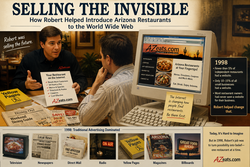
How Robert Introduce Arizona Restaurants to the World Wide Web
When people think about selling websites today, they often imagine showing a customer a portfolio, discussing search engine optimization, social media, and online ordering. The customer already understands why a website matters. The salesperson's job is simply to explain why their company is the best choice.
That was not the world Robert walked into in 1998.
In 1998, advertising was still dominated by traditional media. Television, newspapers, radio, direct mail, Yellow Pages directories, magazines, and billboards accounted for nearly all advertising dollars. The Internet was still considered an emerging technology, and online advertising was in its infancy. Restaurants relied almost entirely on printed menus, newspaper dining guides, coupon mailers, Yellow Pages display ads, and local radio advertising to reach customers.
For independent restaurants, websites were almost nonexistent.
Most business owners viewed the Internet as something experimental rather than essential.
This was the environment in which Robert began selling restaurant websites.
Selling Something People Had Never Bought
Robert wasn't competing against another web design company.
He was competing against unfamiliarity.
Most restaurant owners had never purchased a website because they had never needed one. They understood newspaper advertisements. They understood Yellow Pages listings. They understood coupon mailers and direct mail campaigns.
A website was different.
There was nothing to hold in your hands.
There was no printed brochure that demonstrated its value.
There were very few examples to point to.
Most restaurant owners had never visited another restaurant's website because so few existed.
Before Robert could sell a website, he first had to explain why the World Wide Web mattered at all.
Every sales call began with education.
Bill Learned the Lesson First
Before AZeats focused on restaurants, Bill attempted to sell websites to small businesses for his website called AZ-Guide.
He never sold a single website.
Bill vividly remembers walking into small businesses with nothing tangible to show. I had no physical product, only the idea of a website. The business owners had never purchased one before, and in their minds they didn't need one.
Looking back, Bill says that he was trying to sell a product before people understood why it existed.
That experience taught me just how difficult the marketplace really was.
Robert accepted that challenge - Robert Was Selling the Future
When Robert agreed to join Bill and suggested they focus exclusively on restaurants, he took on one of the most difficult sales jobs imaginable.
He wasn't simply selling websites.
He was helping restaurant owners imagine a future that didn't yet exist.
Every successful sale required restaurant owners to believe that customers would someday use computers to search for places to eat.
That was far from obvious in 1998.
Many customers still relied on the Yellow Pages, newspaper dining guides, coupon books, or simply driving around looking for a restaurant.
The Internet was a promise, not yet a proven business tool.
Robert sold that promise.
There Was No Product to Hold
One of the greatest challenges was that websites were invisible.
A Yellow Pages salesperson could place a phone book on the table.
A newspaper salesperson could show yesterday's edition.
A direct-mail representative could hand over a coupon package.
Robert walked into restaurants with little more than his knowledge, enthusiasm, and confidence that the Internet would permanently change the way restaurants reached customers.
He wasn't selling something people already understood.
He was selling a vision of the future.
Every Restaurant Owner Who Said "Yes"
Every restaurant that became an AZeats client deserves recognition.
Those owners became some of Arizona's earliest adopters of the World Wide Web.
They invested in technology that many of their competitors didn't yet understand.
Without realizing it, they helped shape Arizona's transition into the Internet age.
Years later, independent newspapers, magazines, tourism guides, and even USA Today would direct readers to AZeats-hosted restaurant pages, confirming that those early decisions had become part of the restaurant industry's normal way of doing business.
But in 1998, none of that was guaranteed.
Someone had to be first.
Looking Back
Today it is difficult to appreciate how revolutionary those conversations really were.
Modern business owners ask questions about mobile websites, online ordering, Google rankings, and social media.
In 1998, the first question was much simpler:
"Why would my restaurant need a website?"
Robert answered that question hundreds of times.
Each "yes" represented more than a new customer for AZeats.
It represented another Arizona restaurant taking its first step onto the World Wide Web.
Looking back nearly three decades later, I realize that Robert wasn't just selling websites.
He was helping introduce an entire industry to the Internet.
Looking back, it is easy to forget just how uncertain the World Wide Web seemed in 1998. Robert wasn't walking into restaurants selling a product that owners already wanted. He was introducing an entirely new way of thinking about their business. Every conversation required patience, vision, and the ability to help someone imagine a future they couldn't yet see. Long before websites became as common as business cards, Robert was helping independent restaurant owners take their first steps onto the Internet. One restaurant at a time, one conversation at a time, he helped pioneer the adoption of the World Wide Web within Arizona's restaurant industry. Thousands of people would eventually use those websites without ever knowing the effort it took to convince the very first restaurant owner to simply believe that the Internet mattered.
Before websites became commonplace, Robert was helping Arizona restaurants discover the future—one conversation at a time.