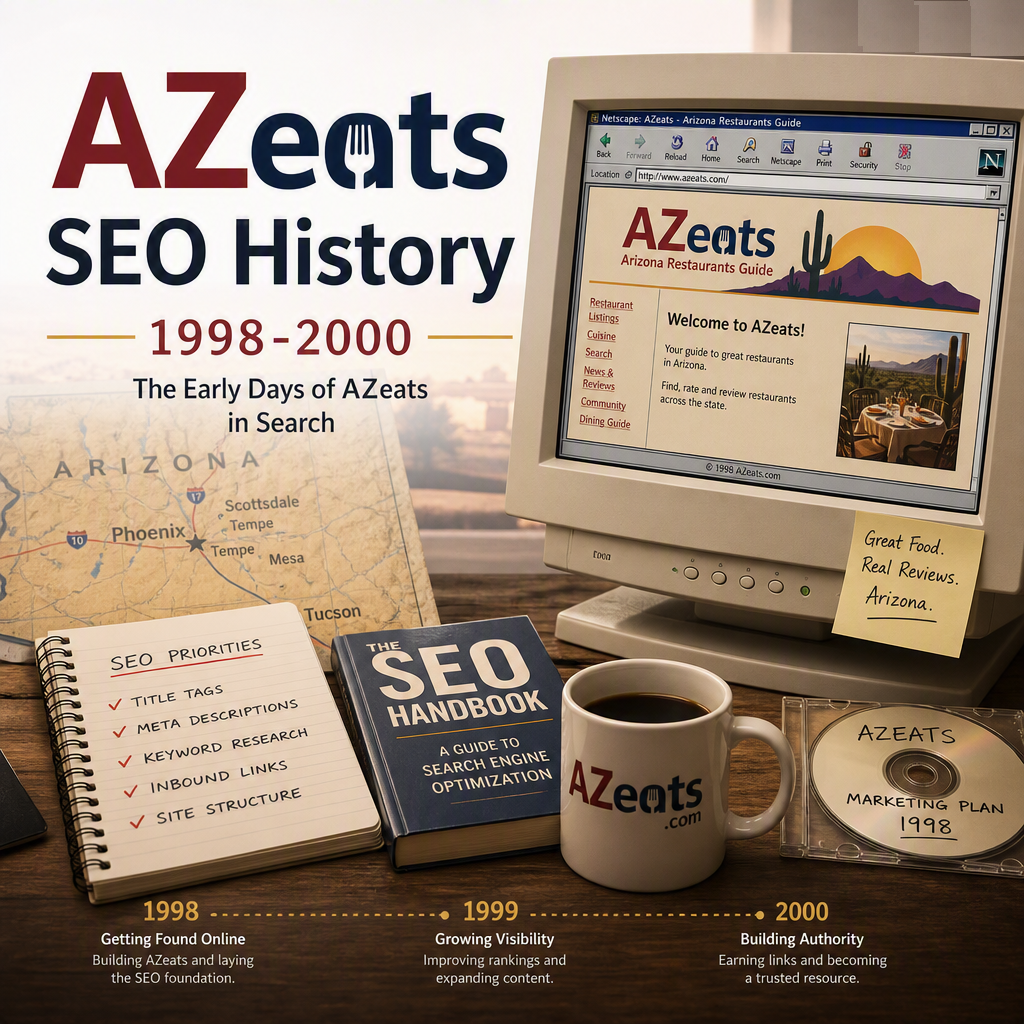
A historical retrospective of Arizona’s first statewide online dining guide — and the two innovators who built it.
Introduction: When the Web Was Young
In the late 1990s, the World Wide Web was still a frontier. Search engines were primitive, business owners were skeptical, and the idea of a restaurant needing a website felt optional at best. Yet in this environment, two Arizona entrepreneurs — Bill and Robert — built a statewide digital dining ecosystem that anticipated the future of online discovery years before Yelp, OpenTable, or Google dominance.
AZeats.com wasn’t just a website. It was a platform, a network, and a traffic engine — designed with purpose, built with precision, and optimized relentlessly.
The Spark: AZ‑Guide.com (1996)
Before AZeats, there was AZ‑Guide.com, launched in 1996. It was Bill’s first attempt at building an all‑inclusive online guide for Arizona. The earliest Wayback Machine capture (December 19, 1996) shows a site that was ambitious, broad, and early.
But the world wasn’t ready.
Business owners didn’t yet understand why they needed a website. Selling webpages was nearly impossible. Bill coded in Notepad, built pages by hand, and tried to convince clients that the web was the future — but the timing wasn’t right.
Still, AZ‑Guide planted the seed.
It taught Bill:
That lesson would matter soon.
The Pivot: Web Scene Inc and the Restaurant Revelation
Bill asked Robert to help sell websites. Robert declined — but he knew someone who published a Scottsdale dining guide. Robert pitched him three times. He declined three times.
Then Robert realized something important:
He believed in the idea more than the person he was pitching.
He returned to Bill with a simple question:
“What if we only do restaurant websites?”
Bill said yes.
AZeats.com was born first. Web Scene Inc followed as the formal business entity behind AZeats, giving the rapidly growing platform a legal and operational foundation. Its creation marked the shift from a single website into a full‑service operation built on recurring revenue, continuous support, and long‑term digital identity management — a philosophy shaped by Bill and Robert’s experience in Offsite Records Management. They weren’t interested in one‑and‑done projects; they were committed to building relationships.
The Launch of AZeats.com (1998)
AZeats.com was officially registered on February 19, 1998. The first Wayback Machine crawl (December 2, 1998) shows a homepage that didn’t just announce a site — it declared a mission:
“Arizona’s Internet Dining Guide.”
Menus. Coupons. Catering. Gift certificates. Virtual tours. Restaurant websites. All connected. All designed to grow.
AZeats wasn’t a directory. It was a digital dining platform.
The Multi‑Site Architecture: A Traffic Engine Ahead of Its Time
Between 1998 and 2005, AZeats hosted over 200 restaurant websites, each with about five pages:
Each restaurant had:
The Two Strategic Purposes Behind the Architecture
1. Traffic Consolidation
Every restaurant promoted its own domain name — on menus, business cards, newspaper ads, and signage. But every visitor landed on AZeats.com.
This meant:
This was the same principle behind modern platforms — but Bill and Robert were doing it in 1998.
2. Cost Efficiency
Hosting 200+ restaurants under one domain:
It was smart business architecture — and brilliant SEO strategy.
The SEO Tactics That Made AZeats a Powerhouse
Between 1996 and 2000, search engines were primitive. They relied heavily on:
AZeats mastered all of them.
1. Keyword‑Rich Titles
Every page used a structured, SEO‑optimized title format:
Restaurant Name – City – Cuisine
Even if the cuisine wasn’t part of the restaurant’s official name.
2. Meta Tags (Including Duplicate Sets)
Bill intentionally used:
These tactics were extremely effective before Google’s PageRank matured.
3. Manual Search Engine Submission
Every new restaurant website was manually submitted to:
Bill submitted every site, every month, everywhere.
4. FFA Pages & Directories
AZeats submitted homepages to every free‑for‑all link page and directory available. Traffic and search engine rankings improved.
5. Client Logo Backlinks
Every client website displayed a small AZeats logo linking back to AZeats.com. This created a large backlink network.
6. The Unique Banner Exchange (UBE)
AZeats didn’t trade banners. It traded services for exposure.
Participating websites displayed the AZeats banner on their homepage — not buried in a rotating ad block. In return, AZeats promoted their sites through ongoing submissions.
This gave AZeats front‑page visibility across dozens of sites without sacrificing its own homepage real estate.
7. Dine‑mail & NewsBytes
Bill and Robert built their own email subscription system:
AZeats wasn’t just doing SEO — it was doing email marketing before the term existed.
The Workflow: Craftsmanship and Consistency
Bill and a graphic designer visited each restaurant in person. They photographed the space, captured the atmosphere, and built websites that matched the restaurant’s identity.
The workflow:
No templates. No shortcuts. Every site was handcrafted.
The Results: Dominating Search Engines
AZeats ranked at the top of search engines throughout the late 1990s and the early 2000s.
Only when pay‑for‑placement arrived did AZeats appear below sponsored listings — but organic rankings remained strong.
AZeats became:
The Legacy: AZeats.org
Today, AZeats.org exists as the historical archive of AZeats.com.
Its purpose is clear:
To preserve what AZeats.com was and did — and to document how Bill and Robert were early adopters and innovators of the World Wide Web.
AZeats was not a footnote in early web history. It was a case study in innovation, a platform before platforms, and a masterclass in early SEO strategy.
Conclusion: A Vision Ahead of Its Time
Between 1996 and 2000, AZeats.com embodied everything the early web was supposed to become:
Bill and Robert didn’t just build websites. They built a digital ecosystem — one that anticipated the future of online dining discovery years before the rest of the world caught up.
AZeats.com was Arizona’s Internet Dining Guide. AZeats.com was an SEO pioneer. AZeats.com was a platform before platforms.
And thanks to AZeats.org, its history will not be forgotten.