Helping Websites Get Found Before Google Changed Everything
Explore the Original Unique Banner Exchange (UBE) Website
The following 4 archived page links below, and the animated GIF banner at the top of this page are preserved from the original Unique Banner Exchange website (circa 2000). They illustrate how AZeats approached website promotion during the early years of the commercial Internet, when helping people find a website was often as challenging as building it.
Building a website was only the beginning.
During the late 1990s, one of the greatest challenges facing every website owner was finding visitors. Search engines were still in their infancy, social media did not exist, and online advertising was expensive and often ineffective. A beautifully designed website that no one could find was little more than a digital brochure hidden somewhere on the rapidly growing World Wide Web.
AZeats understood that reality from the earliest days of AZeats.
Creating restaurant websites was important, but helping people discover those websites was equally important.
Throughout the history of AZeats, new ideas were constantly developed to attract visitors. Restaurant domain names were registered and promoted. Dine-mail newsletters kept customers returning. Community events and festivals introduced thousands of people to AZeats through printed handouts and face-to-face conversations. Gift certificates encouraged repeat visits, and the shopping cart transformed restaurant websites into revenue-generating tools.
The Unique Banner Exchange (UBE) became another piece of that growing marketing ecosystem.
It was designed to solve one of the Internet's biggest problems: How do people find your website?
Rethinking the Banner Exchange
By the late 1990s, banner exchanges had become one of the Internet's most popular methods of website promotion. The concept was simple: display someone else's advertising banner on your website, and your banner would appear on their site. Success depended on impressions and click-through rates.
Most banner exchanges looked alike.
The Unique Banner Exchange did not.
UBE challenged one of the Internet's accepted marketing models. Rather than exchanging banners, it exchanged something far more valuable—website promotion itself. As the UBE website explained: "We are not just exchanging banners, we are exchanging submissions for banner placement."
That single sentence defined everything that made Unique Banner Exchange unique.
A Different Kind of Exchange
Instead of simply exchanging banners, members placed a small UBE code on the homepage of their website. The code would load a banner hosted on the AZeats.com server. In return, UBE actively promoted their website by submitting it every month to a growing network of Free-For-All (FFA) Links Pages across the Internet.
Initially, the network reached more than 1,700 websites and later expanded to more than 20,000. Other versions of the UBE also promoted member websites through 16 search engines, 121 online directories, and more than 34,000 links pages every month, dramatically increasing their online visibility. Free-For-All Links Pages and online directories were used to generate large numbers of inbound links, because early search engines relied heavily on link popularity as a ranking factor.
The UBE concept was remarkably simple.
Placing the UBE Banner code on your website could result in your site being promoted thousands of times every month.
Instead of asking: "How many times can we display your banner?"
UBE asked a better question: "How many places can we advertise your website?"
More Than Automation
UBE was far more than an automated submission service.
Each member carefully prepared their listing by providing:
Every submission became a miniature advertisement distributed throughout the UBE network. Long before the phrases Search Engine Optimization (SEO) and content marketing entered everyday vocabulary, UBE encouraged members to write descriptive titles and compelling summaries that would attract visitors.
Helping Small Businesses Get Discovered
One of the most appealing aspects of UBE was its accessibility.
Membership was free, allowing individuals, small businesses, and organizations to promote their websites without purchasing expensive online advertising. Members who referred additional websites earned increased promotional benefits, creating an incentive to grow the network while rewarding participation with even more exposure.
UBE also maintained quality standards by accepting only family-friendly "G-rated" banners and rejecting inappropriate or offensive websites. At a time when much of the Internet was becoming cluttered with questionable content, this reflected Web Scene's commitment to building a trustworthy promotional network.
What made UBE particularly valuable to AZeats.com was the way the system created a powerful two-way promotional network without cluttering AZeats webpages with other companies' banner advertisements.
UBE members were required to place the UBE banner code on the homepage of their website. UBE then aggressively promoted that same homepage by submitting it to thousands of FFA links pages. This created a remarkable traffic loop. UBE sent visitors to the other website's homepage, and that homepage was displaying a banner promoting AZeats.com. The more websites UBE promoted, the more places the AZeats banner could be seen.
There was another strategic advantage to the system: the banner code was not simply a static image that members downloaded and forgot about. Because the code was placed on their homepage, AZeats retained control over the graphic being displayed. That meant AZeats could change the message, promotion, or branding in the UBE banner without requiring thousands of participating websites to change their code. The archived UBE pages show the "Current UBE Banner," including the AZeats.com "login/dineout/save$" graphic. That graphic could be changed on hundreds of homepages in a matter of a few minutes.
For AZeats.com, this made UBE much more than an advertising exchange. AZeats did not have to give valuable space on its own restaurant webpages to advertisements from other businesses. Instead, the UBE banner occupied space on hundreds of participating websites while UBE simultaneously drove traffic to those websites. AZeats received promotional exposure, while the participating websites received free traffic -- traffic that would see a banner linked to the AZeats.com homepage.
Search engines pushed AZeats.com higher in the rankings simply because its link appeared on an extraordinary number of homepages, giving it the kind of link popularity early algorithms heavily favored.
UBE essentially reversed the logic of traditional banner exchanges—AZeats banners appeared on the same websites UBE was working hard to promote,
thus driving even more traffic back to AZeats.com.
Part of the AZeats Philosophy
The Unique Banner Exchange was not an isolated project.
It reflected the same philosophy that appeared repeatedly throughout the history of AZeats and Web Scene.
Rather than simply building websites, AZeats continually looked for ways to help those websites succeed.
Looking Back
Today, attracting visitors to a website often means relying on Google, Facebook, Instagram, YouTube, or paid digital advertising.
In 2000, those options either did not exist or were only beginning to emerge.
Entrepreneurs experimented with creative ways to help people discover websites, and the Unique Banner Exchange was one of those innovations. It represents a fascinating snapshot of the early Internet—a time when developers were inventing new marketing ideas almost as quickly as they were building websites.
Although the technology has changed dramatically, one lesson remains exactly the same today as it was then: A website only succeeds if people can find it.
The Unique Banner Exchange was one of the many ways AZeats worked to solve that challenge. It demonstrated the same spirit of innovation that shaped every part of the AZeats story: don't simply build something—build a system that helps it succeed.
The strategy reflected a broader philosophy: build systems that create long‑term benefits for everyone involved.
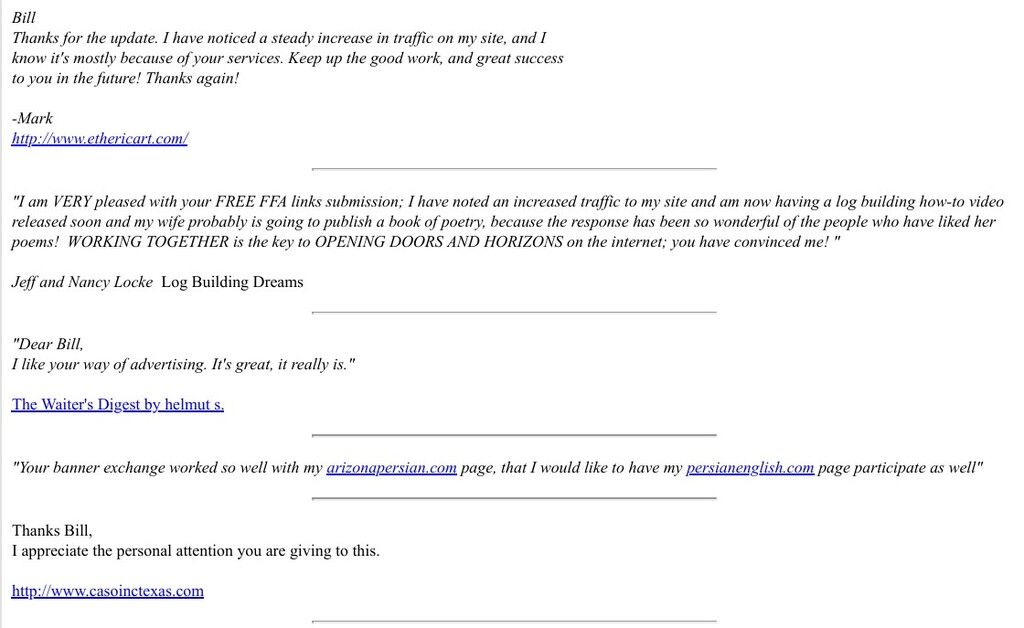
Testimonials below reflected positive experiences from participants, including reports of increased website traffic and appreciation for the personal attention provided.